The 10,000-Hour Gamble
13 October 2025
Is today's AI mastery only a temporary advantage?
AI-generated summary
Extending two earlier articles, Foster-Fletcher asks whether thousands of hours spent mastering today's LLMs are a sound investment or a gamble against an imminent architectural shift towards verifiable reasoning. He weighs the case that probabilistic systems will persist, since commercial incentives reward perfecting the simulation of reason over replacing it, against neuro-symbolic and causal alternatives that could render current skills obsolete. He concludes the durable prize is 'computational scepticism', a transferable discipline of intellectual independence from any plausible-sounding system.
My previous articles have explored two connected ideas. First, in "The Gravity of the Generic," I argued that Large Language Models exert a powerful pull towards a mediocre consensus.
Second, in "The 10,000-hour sprint," I made the case that genuine AI mastery requires a deep investment in the "purposeful practice" of this resistance. But this argument rests on an assumption: that Large Language Models will remain, at their core, flawed probability engines that require a human partner to guide them towards valuable, original outcomes.
Dedicating thousands of hours in pursuit of LLM mastery is something of a gamble, and whether it's a worthwhile investment of time depends on whether the current limitations of LLMs persist.
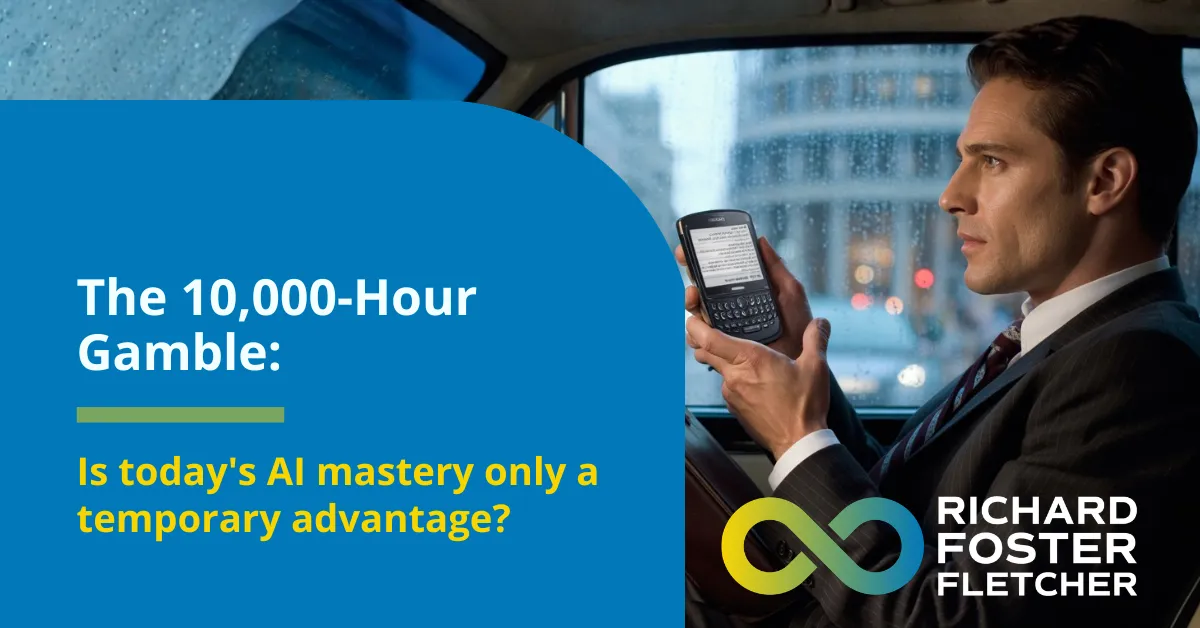
If a genuine architectural breakthrough is imminent, such as a shift from probabilistic systems to verifiable reasoning, then the thousands of hours being invested by today's AI masters could be a colossal waste of effort. Such a breakthrough would see us witnessing a generation of experts mastering the cognitive equivalent of becoming a BlackBerry power user in 2006, a hard-won skill on the verge of being made irrelevant by a paradigm shift. Back in 2007 it was the touch screen. In 2027, it could be the arrival of systems that do not just mimic reason but possess it.
The plausibility of this bet rests on a single, critical question: Are the flaws in today's AI a temporary bug or a permanent feature?
Examining the Argument That AI's Probabilistic Nature Will Persist
Current large language models are, at their core, probability engines. They are trained not to reason from first principles, but to predict the most plausible next word based on the statistical patterns in their training data. This is not a temporary flaw that can be patched in a future update; it is the mathematical foundation of how they function. Every new model generation and breakthrough in training efficiency does not represent a leap to a new kind of reason, but merely a refinement of the existing probabilistic architecture. This means that while they may be getting better at pattern-matching, they are not moving closer to genuine comprehension.
The optimists argue that emergent capabilities like "chain-of-thought" are signs of a deeper understanding. A more sober analysis suggests that we are witnessing the perfection of mimicry, not the birth of reason. A model that "shows its working" is not actually working through the problem; it is generating a sequence of text that looks like a plausible explanation because that is what appeared in its training data.
This distinction is critical.
An AI doesn't think through a problem and then explain its logic. The 'reasoning' it shows you is just another plausible-sounding output, created by the same statistical system that generated the answer itself.
If this fundamental limitation persists, then the practitioners logging thousands of hours of cognitive combat with these systems are developing durable expertise. Their skill isn't in operating today's specific models but in maintaining intellectual independence from any probability-based system. That capability becomes more, not less, valuable as these systems become more sophisticated and their mimicry more convincing.
Their skill is not in mastering the quirks of today's specific models, but in developing the strategic discipline to counteract the inherent flaws of any probability-based system. Potentially a strong bet.
The Alternative Future: A Breakthrough That Makes Today's AI Skills Obsolete
But what if a fundamental architectural breakthrough is imminent? This would not be a matter of bigger models or better training, but a genuinely different approach to artificial reasoning. It could lead to systems that move beyond predicting the next token, to demonstrating a real grasp of concepts, an ability to verify claims against reality, and a capacity to acknowledge genuine uncertainty rather than just performing it.
In this scenario, the thousands of hours spent wrestling with today's LLMs would become largely worthless. The cognitive patterns developed to combat hallucinations, resist consensus drift, and extract non-obvious insights from probability engines would all become unnecessary overhead when dealing with systems that do not have these flaws.
It would be like spending years mastering the quirks of early automobile engines, learning to hand-crank start them, adjust the spark advance while driving, and regulate the fuel mixture manually, only to find yourself in the era of electronic fuel injection. Your hard-won expertise would not transfer; it would become quaint historical knowledge.
The practitioners who've invested years in mastering prompt engineering, in learning the specific failure modes of different models, in developing intuition for when GPT hallucinates versus when Claude is being overly cautious, they might find themselves outperformed by newcomers (and oldcomers) who can now simply interact with genuinely intelligent systems, naturally.
How could this scenario be possible?
The path beyond today’s probability engines is already being explored in research labs. One promising avenue is neuro-symbolic AI, which aims to combine the pattern-matching strengths of neural networks with the formal logic of classical symbolic reasoning. Such a hybrid system would not just predict a plausible answer but could construct a logically verifiable one. Another path lies in causal reasoning, where a model builds an internal "world model" of cause and effect, allowing it to move beyond correlation to genuine, first-principles thinking. These are not incremental improvements; they are entirely different architectures for intelligence, and a breakthrough in any one of them could represent a paradigm shift.
The Commercial Incentives That Reinforce AI's Current Limitations
But let’s be clear, the current LLM technological path is not accidental; it is a direct consequence of commercial interests. A genuine architectural breakthrough would require immense investment in a fundamentally different, and far less scalable, approach. The current paradigm of probability engines, however, is a remarkably efficient business model. It is built on a single, repeatable architecture that can be trained on vast, undifferentiated data. The major AI labs have every incentive to refine this approach, not to replace it.
‘Following the money' leads to the conclusion that the AI labs' commercial incentive is not to build a better form of reason, but to perfect the simulation of it.
More importantly, a probabilistic solution is a far more saleable one. An AI that provides instant, confident, and plausible-sounding answers creates a powerful illusion of competence and efficiency. It is a product that appears to solve problems with minimal friction. A system built on verifiable reasoning, in contrast, would be a much harder sell. It would be slower, would openly admit uncertainty, and would constantly require the user to engage in the difficult work of auditing its logical steps. One sells the satisfying performance of a quick answer; the other sells the difficult process of arriving at a correct one. Given the choice, the market will almost always choose the former.
Why the 10,000 Hours of Practice Are Not a Wasted Effort
The strategic dilemma, then, is not a simple binary bet on whether today's technology will become obsolete. The evidence suggests the commercial incentives are aligned to perfect the simulation of reason, not to replace it. This makes the persistence of probabilistic systems the most likely near-term future. The thousands of hours invested in mastering them are not a wasted effort.
However, the real value of this investment is not in learning the specific quirks of today's models. The true, durable capability being built is a form of computational scepticism; the disciplined, hard-won practice of maintaining intellectual independence from any system that generates plausible-seeming outputs. The practitioners spending thousands of hours in dialogue with current AI are not just learning prompt patterns. They are developing a deep intuition for when any system, regardless of its architecture, is operating beyond its capabilities.
Those mastering AI LLMs are building the muscle memory for the kind of rigorous validation that will remain necessary as long as we delegate cognitive work to machines.
This "meta-skill," the ability to remain cognitively sovereign while using powerful tools, might be the only expertise that is likely to transfer across paradigm shifts. The person who has spent 10,000 hours learning to extract genuine insights from ChatGPT may not know the specific failure modes of a future system, but they will recognise the texture of synthetic thought and the difference between genuine reasoning and a sophisticated imitation. IMO, this is the real prize of the 10,000-hour sprint.
The question of credibility arises if leaders can no longer evaluate the work they lead Senior leaders who built their careers on pre-AI expertise seem to be finding themselves unable to engage substantively with practitioners who've logged thousands of hours in cognitive combat with LLMs.
A managing partner who's never spent eight hours wrestling with model hallucinations cannot meaningfully assess someone who has spent eight hundred. A CEO who delegates all AI interaction to subordinates has no framework for understanding where machine capability ends and human judgment begins.
If they lack the vocabulary to discuss prompt engineering beyond surface metaphors, the experiential foundation to distinguish between genuine AI mastery and sophisticated mediocrity, and most critically, the foundational judgment to guide a process they no longer understand, a profound leadership gap is the inevitable result.
Leaders sit atop organisations whose competitive advantage increasingly depends on capabilities they may not be able to directly perceive, evaluate, or develop.