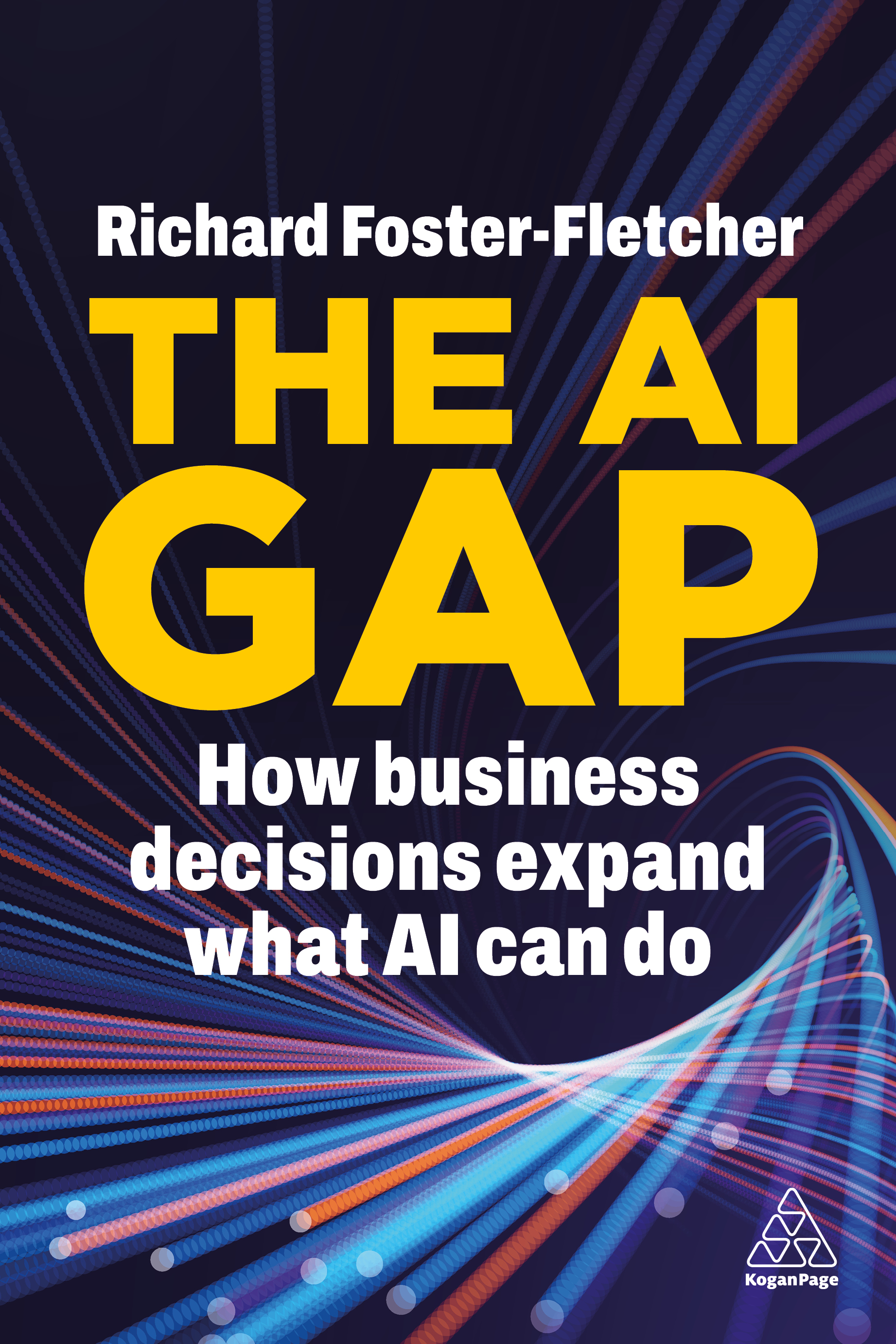
The book

The AI Gap

Why Enterprise AI Produces Output Without Insight

Richard Foster-FletcherPublished by Kogan PageJune 2027

Once a financial or strategic commitment depends on AI, evidence is needed that the system placed into use can do the work that commitment assumes.

The AI Gap reveals why that evidence is missing. It exposes how standard corporate governance and the “software playbook” systematically neuter AI before it reaches the workforce, leaving senior leaders accountable for boardroom promises their deployed systems can no longer deliver.

The AI Gap: Why Enterprise AI Produces Output Without Insight, by Richard Foster-Fletcher

Cover design subject to change.

The argument

The risk begins with a simple disconnect.

Companies are counting on AI to fundamentally change their economics, yet they govern and measure it through the exact same structures used for legacy IT. The AI Gap challenges the assumption that operational productivity is the end goal.

It explores the hidden cost of stripping away capability to make a system feel safe, and asks what happens when an organisation makes itself unable to recognise the intelligence it actually needs.

Inside the book

The AI Gap examines these limits in two distinct parts.

Part One

The capability required

The first half addresses the gap between the AI a company has actually deployed and the capability required to meet the commitments it has made to the market. It unpacks how standard corporate filters, including procurement processes and hidden system prompts, unintentionally narrow a model’s potential.

Has the organisation deployed a system genuinely capable of doing what it is counting on it to do?

Part Two

The capability permitted

The second half examines the gap between the narrow, operational uses an organisation currently permits and what the actual frontier of AI could contribute. It traces why companies instinctively built AI downward into operations, rushing to justify the technology by applying it to familiar productivity problems, rather than pointing it upward into executive judgement.

This section asks what happens when an organisation’s early choices structurally lock it out of the greatest potential returns. It explores the hidden vulnerabilities of using AI at the top tier, and challenges leaders to consider how they would even recognise that AI has become capable of changing consequential decisions when their own corporate machinery has actively shut it out of that space.

Evidence used in the book

The argument begins with records that can be examined.

01

Corporate statements

Annual reports, earnings calls and public commitments identify the outcomes attached to AI.

02

Technical accounts

Deployment reports and vendor documentation show how models enter working systems.

03

Direct model work

The same serious material is examined through different systems to compare their contribution.

04

MKAI studies

Published methods, source records and proprietary research provide the foundation. This body of evidence tracks how AI is governed, deployed and restricted inside large organisations.

Testing the deployed capability

Adoption Without Capability Reporting examines the gap between deployment claims and measured capability.

The Subtraction Study shows how institutional constraints actively remove intelligence.

The Liability Transfer highlights the disconnect between vendor controls and enterprise accountability.

Testing the permitted use

The Unread Instruction reveals the hidden system prompts that shape every answer.

The Sparring Partner Study tests how governed enterprise systems respond to senior executive strategy.

Read the research map at MKAI.org →
The inquiry

From an expected result to the system expected to support it

The AI Gap asks what an AI system must be able to do for a stated financial or strategic outcome to follow. It asks which system was tested against that requirement, and what evidence connects the system placed into use with the eventual result.

It also asks how that evidence should change as stronger systems appear, and how a material difference between systems could be recognised by the business.

The disconnect occurs because the people setting the technical constraints are rarely the same people holding the P&L responsibility. The book examines how this structural divide hides the true limits of the deployed system.

Research standards

How claims are handled

Direct documentation. Claims about named companies and systems rest strictly on public records or direct technical evidence.

Observation and inference. What the evidence shows is carefully separated from the explanation drawn from it.

Competing explanations. Alternative readings remain open where the available material supports more than one account.

Read the evidence standards at MKAI.org →
The intended reader

Written for people carrying responsibility

The book is written for leaders accountable for financial and strategic outcomes involving AI. This includes those managing substantial P&Ls, overseeing major corporate functions and directing investment decisions.

It assumes familiarity with organisational decisions and competing forms of evidence, without requiring a technical or engineering background.

The author

Richard Foster-Fletcher

Richard Foster-Fletcher is an independent researcher and keynote speaker examining AI capability, organisational judgement, accountability and the information available to senior decision-makers.

Through MKAI, he publishes studies of corporate reporting, enterprise systems and the structural effects of AI within large organisations.

The book

The AI Gap

Why Enterprise AI Produces Output Without Insight

Author
Richard Foster-Fletcher
Publisher
Kogan Page
Publication
June 2027
Cover
Design subject to change
Publication updates

Follow the development of the book

Receive confirmed publication news and selected research findings from The AI Gap. Updates are sent when substantive material is available.

The address will only be used for updates connected with the book.