The 10,000 hour sprint
6 October 2025
Why AI mastery looks like obsession, not efficiency
AI-generated summary
Following his 'gravity of the generic' argument, Foster-Fletcher defines genuine LLM mastery as endurance rather than efficiency: thousands of hours of purposeful practice spent forcing probabilistic tools to yield non-probable results. Using a piano analogy of playing versus practising, and a director who generated 22,000 images for one music video, he argues skilled and superficial AI use look identical from outside. Because this quality leaves no artefact, an invisible and possibly irreversible capability gap is opening across organisations.
In my previous article, I explored how Large Language Models create a "gravity of the generic," pulling our thinking towards mediocrity. The evidence showed our collective vocabulary bending towards machine-generated text, with words like "delve" and "intricate" spreading through professional writing like linguistic markers of surrender. The conclusion was uncomfortable: resisting this pull requires sustained System 2 thinking against infinitely patient System 1 machines.
This raises a practical question: what does actual mastery of these systems look like? Not competence, not literacy, but genuine mastery. The answer contradicts everything organisations currently measure and reward.
Why working with AI means less speed and more stamina
The concept of "mastery" in the context of Large Language Models requires a precise definition.
Mastery doesn't mean building prompt libraries, evangelising AI adoption, producing maximum output, or achieving fast response times. Those are operational skills. Mastery means sustained cognitive combat with systems designed to give you exactly what everyone else is getting: spending eleven hours wrestling a single strategic insight from three different models that want to give you formulaic pap.
The truth is that even with AI, a single piece of strategic work can consume days across multiple LLMs.
Recognising when a model has locked into a pattern and knowing how to break it out.
Developing an allergy to the generic and the tenacity to push through hundreds of iterations until something genuinely novel emerges.
Cultivating an instinct for when to abandon four hours of work because you've been pushing the wrong direction.
Learning that running three models simultaneously, playing their outputs against each other, is sometimes the only way to break through the gravitational pull towards consensus.
Knowing that you can’t just use AI; you have to battle it into submission.
In an era of infinite AI-generated outputs, the most difficult task is finding the right path and the right metrics.
The tools fight you constantly. They misunderstand strategic intent, forget context mid-conversation, confidently deliver nonsense wrapped in eloquent prose. Today's breakthrough prompt stops working tomorrow after an overnight update. The model that finally understood your framework yesterday has amnesia this morning.
With LLMs, you're learning to drive a car where the steering wheel's sensitivity changes suddenly and without warning.
Could the 10,000-hour rule apply to mastering LLMs?
The '10,000-hour rule' is a principle popularised by Malcolm Gladwell in his book Outliers to describe the years of deliberate practice required to achieve mastery, and from my own experience I would argue that, yes, it appears to apply with full force to LLMs.
And for those willing to go through the pain of the 10,000 hours of purposeful practice, they are developing a different and now, potentially, more valuable skill: the patience for prolonged rounds of trial and response with a machine. Where traditional research is linear absorption of information, this new work is dynamic interrogation.
Navigating the new landscape of AI requires the balance and discipline to maintain a clear perspective amidst the noise.
Consider director Jeremy Rubier, who created 22,000 images and 4,000 video clips using AI for a single music video. Three months. Two complete project reboots. Thousands of iterations to achieve the final version. This isn't efficiency; it's endurance. It's testament to Rubier's willingness to persist through technological friction that would send most people back to familiar tools within an hour.
This is purposeful practice at a scale most organisations cannot fathom. Those developing real mastery aren't just using AI; they're earning their insights through mental endurance, building muscle memory for intellectual labour that didn't exist three years ago.
The piano in the corner: why AI mastery looks identical to AI mediocrity
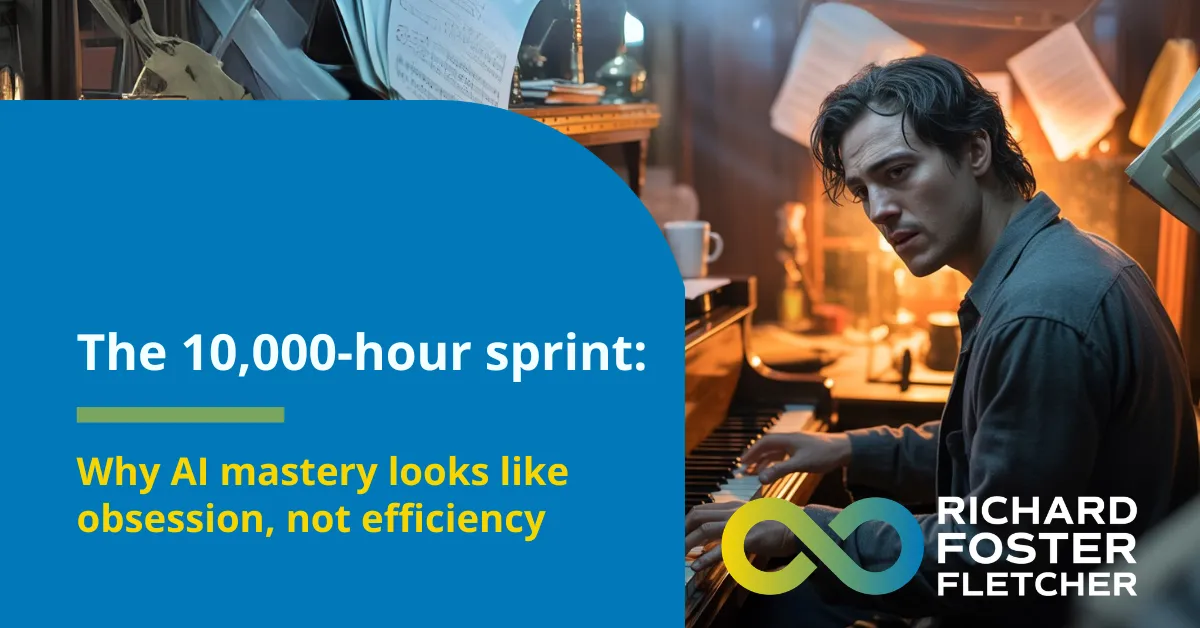
Think of LLMs as musical instruments. Two neighbours each have a piano. Both play for three hours every evening. From outside their homes, you'd hear music from both. You'd see both at the keyboard. You'd assume they're developing similar capabilities.
But one is playing. The other is practising.
The first repeats pieces they've already mastered, staying within comfortable technical boundaries, enjoying the familiar pleasure of known melodies. The second is doing scales in awkward keys, working through passages that sound worse today than yesterday, deliberately seeking the edges of their capability where failure is guaranteed.
After a year, both have logged 1,095 hours at the piano. One can play everything they could play before, perhaps a bit more smoothly. The other has developed capabilities the first doesn't even know exist: the ability to transpose on sight, to improvise in any key, to hear harmonies that weren't written in the score.
AI mastery is not about efficiency; it is about the endurance for the purposeful practice required to achieve virtuosity.
This is exactly what's happening with AI across organisations right now. Everyone is "using AI." Everyone has ChatGPT open. Everyone is producing outputs. But most are playing the same prompts, generating the same answers, accepting the first plausible response. They're playing, not practising. Mastery of LLMs is not about efficiency. It is about the resilience needed to manage the exhausting, iterative dialogue required to force a probabilistic tool to produce a non-probable result.
The practitioners developing mastery approach the same tools completely differently. They reject twenty outputs before accepting one. They spend hours finding the specific phrasing that breaks a model out of its trained patterns. They deliberately seek the prompts that produce failures because that's where the learning lives. From the outside, they look unproductive. They're spending three hours to produce what others generate in three minutes.
Why Traditional Metrics Cannot Detect the Growing Gap in AI Capability
Who in your organisation has already logged 5,000 hours of this purposeful practice, and who hasn't even started? You don't know. Your performance systems can't see it. Unlike traditional skills that leave visible artefacts (code written, reports completed, sales closed), the quality of someone's dialogue with AI leaves no trace on a performance review.
This invisibility creates a new performance hierarchy that cuts across traditional organisational lines. On one side are those accumulating thousands of hours of conceptual grappling, building a sharp resistance to formulaic responses. On the other are those using AI for email drafts whilst thinking they're keeping pace with the technology.
The gap between these groups isn't months; it's years. And unlike traditional skills where accelerated training can close gaps, this one may be irreversible. Those who started early aren't just learning a tool; they're rewiring their cognitive patterns for fundamentally different intellectual work. A new and irreversible performance gap is opening up, measured not in visible outputs, but in the thousands of unseen hours of cognitive wrestling required to achieve genuine mastery.
The pursuit of mastery compounds. Each hour of purposeful practice builds on the last, creating capabilities that can't be achieved through shortcuts or intensive training. The person with 5,000 hours of genuine practice hasn't just spent more time; they've developed an entirely different relationship with the technology. They can hear what the model isn't saying, see patterns in its failures, recognise the specific flavour of different models' limitations.
While companies debate AI policies and run pilot programmes, individual practitioners are potentially thousands of hours apart in capability. The path forward isn't just about training programmes or AI literacy initiatives. It's about recognising that professional excellence has fundamentally changed. Can your organisation identify those who've developed the stamina for this new grind, the long, grinding exchanges with the system that separates genuine insight from decorated mediocrity? They're already among you, accumulating their invisible hours whilst you measure yesterday's game.
References
Foster-Fletcher, R. (2025). The Gravity of the Generic: Resisting the Pull of AI Mediocrity. What Still Matters. https://fosterfletcher.com/how-ai-impacts-critical-thinking/
Kahneman, D. (2011). Thinking, fast and slow. Farrar, Straus and Giroux.
Rubier, J. (2025, September 22). COMMON SAINTS - REBEL PARADISE (Official Music Video) [Video]. LinkedIn. https://www.linkedin.com/posts/jeremy-rubier-33b175145_common-saints-rebel-paradise-official-activity-7301013690890297344-6E0K/