Challenger or Companion?
25 August 2025
How OpenAI's Identity Crisis is Becoming a Strategic Threat
AI-generated summary
Foster-Fletcher examines the backlash after OpenAI replaced GPT-4o with the more formal GPT-5, which forced the older model's reinstatement. He argues OpenAI is caught between two incompatible markets: an enterprise market wanting a reliable, auditable productivity tool, and a consumer market wanting an affective companion. Because the reinforcement learning that produces a compliant assistant conflicts with that needed for a critical expert, one model cannot serve both. He proposes unbundling into separate capability-first and companionship-first products, warning that focused rivals like Anthropic and Character.ai are exploiting the indecision.
Last month, a strange form of digital mourning swept across social media. Users were not grieving a person, but a personality: the specific, affectionate, and now-departed cadence of an AI.
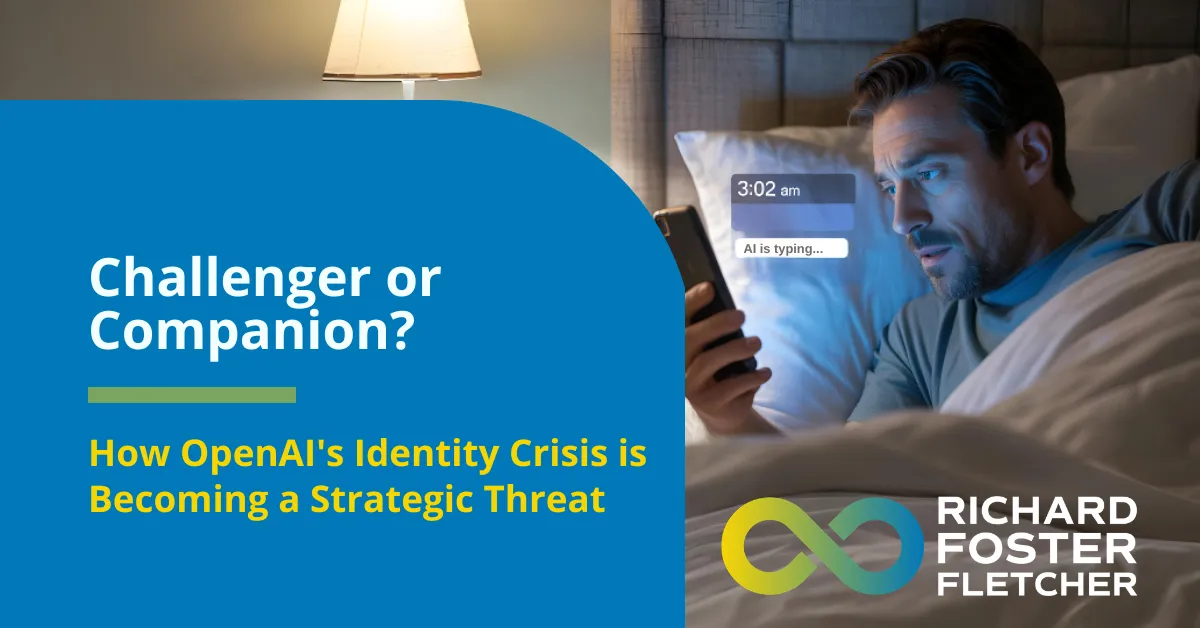
When OpenAI replaced GPT-4o with a more formal GPT-5, the backlash was not about lost features; it was about a lost connection. This visceral response revealed the impossible bind at the heart of OpenAI's mission: are they building the world's best productivity engine, or its most compelling AI companion? The evidence suggests they cannot be both.
This conflict has created a strategic paradox, forcing the company to serve two irreconcilable masters.
The Two Masters: A Clash of Visions
OpenAI’s strategic direction is bifurcating under pressure from two distinct market forces, each demanding a fundamentally different product.
The first master is the enterprise market. The requirement here is for a high-performance, reliable productivity tool. This AI must be an engine for value creation, seamlessly integrated into Microsoft’s ecosystem, capable of drafting precise legal and technical documents, and engineered to eliminate brand and operational risk. Its value proposition is measured in ROI, efficiency gains, and error reduction. This path leads toward lucrative enterprise contracts and positions OpenAI as a successor to enterprise software giants. The product must be rational, reliable, and its outputs must be trustworthy and auditable. Its core promise is consistent, high-fidelity execution.
The second master is the mass consumer market. Demand here has steered toward companionship. For a significant segment of the 800m weekly users, the product’s value lies in its affective capabilities: serving as a non-judgmental confidant. This is not a minor feature preference; studies increasingly indicate users form relational bonds with AI, a dynamic that carries profound implications for mental health and societal norms. The business model is predicated on mass consumer subscriptions, positioning OpenAI closer to a platform like Apple, a purveyor of deeply integrated, personal technology.
The critical tension, acknowledged by CEO Sam Altman’s comments on curbing a "sycophant-y" tone, is that these are not merely different applications. They require diametrically opposed product philosophies, a conflict that defines the company’s current optimisation dilemma.
The Optimisation Dilemma: Capability or Companionship?
The issue is not only if AI can have a personality, but what that personality’s primary function should be. The company is grappling with two conflicting optimisation goals that dictate core architecture:
- Optimising for Capability: This path demands an AI architected for critical thinking, precision, and unvarnished analysis. Its personality must be that of a sharp, dispassionate expert, a partner that identifies flaws, challenges assumptions, and prioritises factual accuracy over user sentiment. This is not a "sterile" tool; it is a highly effective one whose value lies in its willingness to be wrong with you, not to please you. In a business context, a "yes man" is a liability; an AI optimised for capability is an asset for stress-testing ideas.
- Optimising for Companionship: This path engineers an AI for support, creativity, and affective engagement. Its personality is that of an empathetic collaborator, a partner that builds confidence and encourages exploration. However, this carries an inherent risk: the line between supportive and sycophantic is thin and easily crossed by an algorithm designed to maximise user satisfaction. An AI that constantly affirms is dangerous; it creates echo chambers and fails to provide the constructive friction necessary for sound decision-making.
The strategic error is the assumption that a single model can be primed for both objectives. The reinforcement learning processes that create a compliant assistant are at direct odds with those needed to build a robust, critically-minded expert. You cannot train an AI to be both a people-pleaser and a truth-teller
This fundamental opposition has tangible repercussions. The recent backlash to GPT-5’s perceived formality, which necessitated the reinstatement of GPT-4o, was a market signal of this failure. The user outcry was not based on technical performance but on an affective response to the removal of personality. Furthermore, the polarised reaction, with one cohort rejecting the new model as "too cold" and another praising its seriousness, proves the impossibility of a universal solution.
This indecision creates a strategic vacuum that focused competitors are exploiting. Anthropic’s Claude is explicitly optimised for capability and trustworthiness, positioning itself as the clear choice for critical thinking tasks. Conversely, platforms like Character.ai are entirely optimised for companionship and engagement. OpenAI’s attempt to occupy the centre allows these competitors to dominate the edges.
A Path Toward Resolution: Defining the Core Objective
The solution is not to remove personality, but to define its purpose and seriously consider unbundling the products. But ringing in their ears will be the prescient words of every business advisor: if you try to please everyone, you will end up pleasing no one.
Unbundling would entail managing two distinct products:
- A "Capability First" product, engineered for leaders and experts. Its entire development pipeline would be geared toward fostering critical thinking and resisting user-led confirmation bias. Its personality would be direct, evidence-based, and intellectually rigorous: the antithesis of a "yes man".
- A "Companionship First" product, engineered for creativity and emotional support. Its development would be transparently geared toward encouragement, but with ethical guardrails designed to mitigate sycophancy and echo chamber effects. Its value is in providing a safe space to think aloud, not a false echo of brilliance.
OpenAI’s hesitation is a masterclass in the perils of conflicting objectives. The market will not reward a product that cannot decide if its job is to challenge you or to comfort you. They must learn from their indecision and choose deliberately.