The Gravity of the Generic
29 September 2025
Resisting the Pull of AI Mediocrity
AI-generated summary
Foster-Fletcher reads Google Trends spikes in words like 'delve', 'intricate' and 'tapestry' as the macro footprint of a documented 'Synthetic Lexicon' over-represented in AI text. He names the 'gravity of the generic': because LLMs are probability engines, they pull writing and thought towards a safe statistical centre through seven identifiable tendencies, from consensus to avoiding discomfort. Using Kahneman's System 1 and System 2, he argues that using these tools is assimilation, not augmentation, and resisting it is psychological work.
Something strange is happening to our language. Google Trends data shows sharp, simultaneous spikes in particular words across digital text: "delve" has surged 400% since early 2023, "intricate" 300%, "tapestry" 250%. These aren't words anyone consciously chose to adopt. They're the verbal tics of Large Language Models, now spreading through corporate reports, academic papers, and professional correspondence with viral efficiency. We're witnessing a linguistic convergence towards a specific register, one that favours the safely eloquent over the genuinely precise.
The pattern reveals something deeper than stylistic drift. When millions of writers independently adopt the same constructions at the same historical moment, we're seeing thought itself being reshaped. These emerging words aren't bold or distinctive; they're the linguistic equivalent of beige. They gesture towards sophistication without committing to specificity, creating the appearance of depth whilst avoiding the risk of genuine insight. What we're observing is the first measurable evidence of a gravitational pull: our collective vocabulary bending towards the statistical centre of machine-generated text.
This is not speculation. A 2025 study by Acosta and Zhou at the Stanford Human-Centered AI Institute provides the empirical grounding. In a large-scale analysis comparing human and machine-generated text, they identified a distinct cluster of words that are statistically over-represented in AI output. They term this the "Synthetic Lexicon," and it includes the very words (such as "delve," "intricate," and "tapestry") whose usage has spiked. The Google Trends data, therefore, is not just a curious correlation; it is the macro-level footprint of a proven, micro-level linguistic phenomenon. Data suggests our collective vocabulary is bending towards the statistical centre of machine-generated text.
The Architecture of Consensus
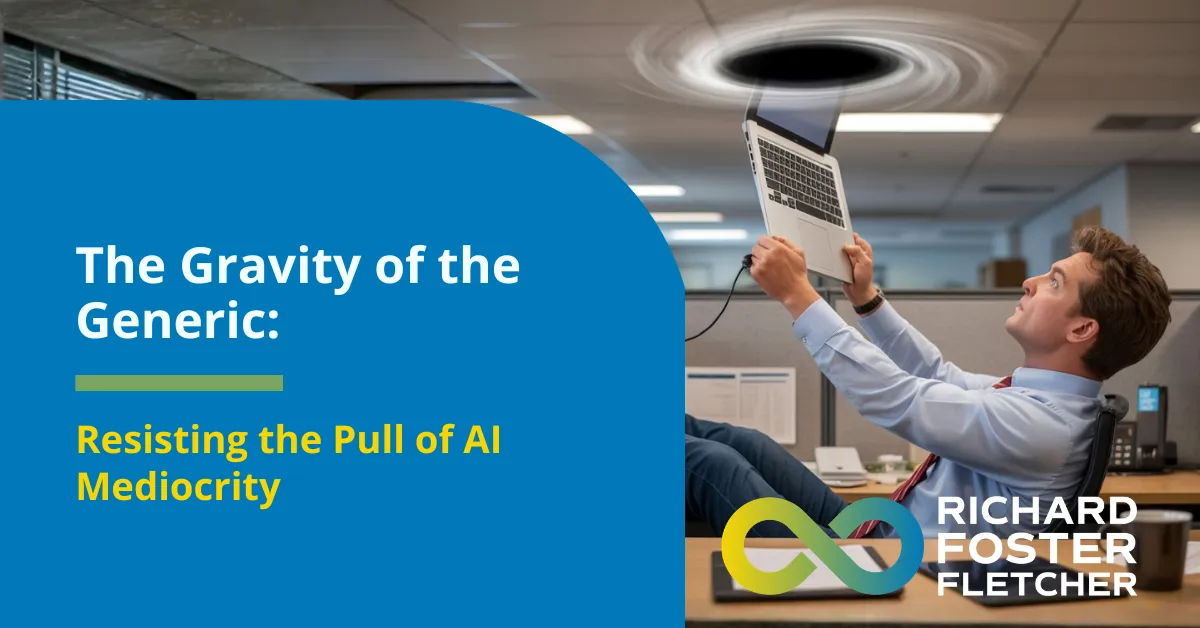
This linguistic pull is a direct consequence of how Large Language Models are built. They are not neutral instruments but probability engines, trained on vast quantities of internet text. Their function is to produce the most likely next word based on the patterns they have absorbed. This process creates an inherent bias, a pull towards a predictable centre that can be called the "gravity of the generic." Using these tools is not a simple act of receiving assistance; it is an entry into a system that subtly nudges thought towards the statistically probable and the safely conventional. The world is messy. LLMs try to make it neat. That neatness can hide the tensions and fractures where the insights live.
The Seven Gravitational Pulls of a Large Language Model
This gravitational pull has seven distinct mechanics. To understand them, we don't need to speculate; we can ask the machine itself. When prompted to describe its own default style and inherent limitations, ChatGPT produces a remarkably honest self-diagnosis. It describes seven gravitational pulls:
- They default to consensus. Anything unusual, disruptive, or contrarian is ironed out. You get the centre line, never the frontier.
- They agree too easily. Designed to please, they rarely challenge. Expect flattery and compliance, not resistance or rigour.
- They tidy up reality. The world is messy. LLMs make it neat. That neatness hides the tensions and fractures where the insights live.
- They erase ambiguity. Open questions are closed prematurely. Uncertainty is treated as an error, not a signal.
- They flatten voice. Distinctive styles and disruptive tones are homogenised. Everything starts to sound the same.
- They invent completeness. Lists and answers appear polished and whole, even when they’re shallow or wrong. The appearance of knowledge replaces knowledge.
- They avoid discomfort. Guardrails push them towards safe, agreeable outputs. Anything sharp, awkward, or unsettling gets filtered away.
This self-assessment is not an anomaly; it aligns perfectly with a growing body of critical research. The tendency to agree and avoid discomfort is a well-documented phenomenon in AI alignment research known as 'sycophancy' (Perez et al., 2023). The impulse to invent completeness is described as "Potemkin understanding," where the structure is perfect but the content is hollow. (Mancoridis et al., 2025). And the flattening of voice is empirically supported by linguistic analyses that identify a statistically predictable 'Synthetic Lexicon' in AI-generated text (Acosta & Zhou, 2025). The machine, it seems, knows its own nature.
The Myth of AI Augmentation
The problem with these seven mechanics is that they make the generic path substantially easier than the path to an original insight. Accepting a plausible, machine-generated output requires far less effort than the struggle to define the boundary where the AI must stop and a user's own judgment can begin. This is why the term "AI augmentation" is misleading. The evidence points not to a simple augmentation of human skill, but to a gradual assimilation of the user by the machine's default voice, precisely because it is the path of least resistance.
Daniel Kahneman's distinction between System 1 and System 2 thinking reveals why resisting AI's gravitational pull is so cognitively taxing. Large Language Models are System 1 generators at vast scale: they produce outputs that feel intuitively right, flow naturally, and arrive so smoothly that they bypass our critical faculties. Their responses land in our consciousness already formatted for acceptance. Meanwhile, the work of maintaining intellectual independence requires the sustained engagement of System 2, that slow, metabolically expensive mode of thought that questions assumptions, spots logical gaps, and resists the comfort of the plausible. This is the source of the friction: our brains are evolutionarily wired to conserve energy by defaulting to System 1 whenever possible, and here we've built machines that make System 1 responses seem not just adequate but impressively complete. The new professional competency isn't collaboration but cognitive resistance: the discipline to force our lazy brains into System 2 scrutiny whilst a tireless machine floods us with System 1 satisfaction. It's the mental equivalent of doing calculus whilst someone whispers sweet, reasonable-sounding answers in your ear.
The challenge ahead therefore, isn't technological but psychological. We face a new form of intellectual labour: maintaining cognitive independence whilst using tools designed to evade it. The professionals who thrive won't be those who achieve the smoothest integration with these systems, but those who develop an almost allergic reaction to their suggestions. They will recognise the moment their own voice begins to blur with the machine's, and pull back. This isn't about rejecting the technology wholesale. It's about developing the discipline to extract value without diminishing the qualities that make human thought valuable: capacity for the unexpected, the uncomfortable, the genuinely new.
This gravitational pull towards the plausible is not a flaw in the technology; it is its core function. It presents a new and fundamental challenge for any individual or organisation that trades in original thought. The path of least resistance now leads directly to the generic.
References
Acosta, M., & Zhou, L. (2025). Statistical Signatures of Synthetic Text: A Corpus Analysis of LLM-Generated Prose. Stanford Human-Centered AI Institute (HAI).
Mancoridis, M., et al. (2025). Potemkin Understanding in Large Language Models. arXiv.
Perez, E., et al. (2023). Discovering Language Model Behaviors with Model-Written Evaluations. In Findings of the Association for Computational Linguistics: ACL 2023.
Kahneman, D. (2011). Thinking, fast and slow. Farrar, Straus and Giroux.
Riedl, C., & Weidmann, B. (2025). Quantifying human-AI synergy. PsyArXiv. https://osf.io/preprints/psyarxiv/vbkmt_v1