The AI Predictability Trap
21 July 2025
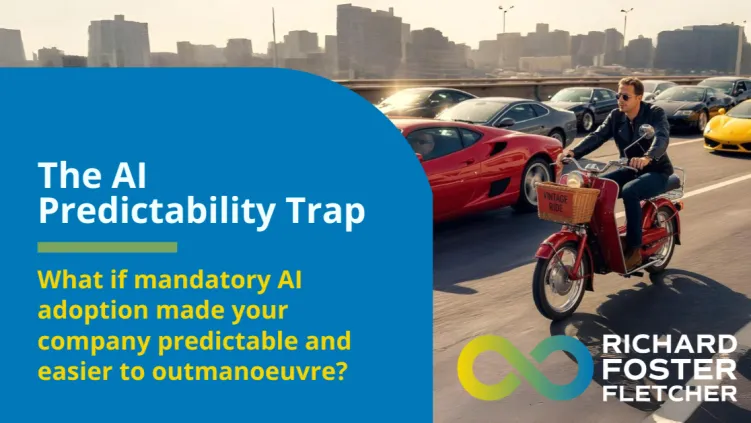
What if mandatory AI adoption made your company predictable and easier to outmanoeuvre?
AI-generated summary
Foster-Fletcher responds to Zapier's decision to make AI fluency mandatory for every hire. He argues that incentivising constant AI use makes an organisation predictable, because AI tools are fundamentally pattern-based and competitors can anticipate decisions that mirror those patterns. Agile startups free from such mandates retain the advantage of choosing when to use AI. Drawing on commentary from several practitioners, he recommends rewarding human judgement that overrides AI and building intentional friction, a theme of his forthcoming book with Paul Levy, arguing surprise is a strategic asset that mandates erode.
Amongst the growing number of corporate mandates for AI usage across the organisation, integration software company Zapier recently announced that AI fluency would become mandatory for every employee they hire.
The company is not alone in making bold moves to position itself as AI-first, with a hiring policy that places artificial intelligence at the core of its organisational culture. Zapier's decision to evaluate employees based on their adoption and use of AI seems logical when viewed through the lens of productivity gains and efficiency. It is, after all, a widely accepted belief that integrating AI into human workflows leads to measurable improvements in output, speed, and cost management. Most organisations, particularly those with a strong focus on scaling processes quickly, see AI adoption not just as beneficial but as essential.
However, this strategy sets in motion a shift.
By explicitly rewarding and therefore incentivising employees for using AI, companies may be implicitly discouraging approaches that challenge or deliberately sidestep the technology.
And here's where I see the catch.
Incentivising employees to consistently integrate AI into their workflows creates predictability, and predictable organisations are easily anticipated, countered, and ultimately defeated.
The Predictability Trap
To be unbeatable, a company must surprise its competitors, whether through innovation, creativity, or agility. The paradox of mandated AI adoption is that it may encourage exactly the opposite outcome. If employees worry that not using AI or challenging its suggestions might jeopardise their roles or bonuses, the safest path becomes using the AI tools frequently and transparently, even in situations where they add little or no value.
AI tools, no matter how advanced, remain fundamentally pattern-based. If a company's processes begin to mirror these predictable patterns, competitors quickly gain insight into its decision-making. The more staff rely on AI, the easier it is for rival organisations to anticipate and counteract moves. A company whose employees are measured by their compliance with AI adoption inevitably loses the strategic advantage of surprise.
Meanwhile, agile competitors, especially startups less bound by internal expectations of AI usage, gain an advantage. While established businesses double down on predictable AI-driven workflows, startups and challenger companies find themselves with a clear opening. Free from internal mandates around AI adoption, smaller companies can strategically decide when and how to use AI. They remain flexible enough to recognise scenarios where purely human-driven insights, ingenuity, or risk-taking significantly outperform machine-generated recommendations.
In this scenario, Zapier's seemingly rational AI policy may paradoxically expose them to greater risk, as competitors exploit the rigidity that comes from a workforce incentivised to conform rather than challenge.
Insights from LinkedIn Leaders
Rajesh Rangarajan, an AI strategist, noted the danger of focusing too narrowly on productivity:
"This focus on productivity risks pushing companies into an exploitation trap, where they optimise for a local maximum and miss AI's true exploratory potential. We see this with sales teams, where the process is amped up without new goals. The real win isn't sending more spam faster; it's using AI as a research analyst to craft one perfect, insight-driven message."
Likewise, Erica S. William, a specialist in data-driven growth, cautioned against viewing AI simply as an automation tool, remarking:
"AI's biggest value isn't in automation but in augmentation. HBR & McKinsey have both cautioned that companies using AI without rethinking work risk reinforcing outdated processes. Many more Kodaks & Nokias will be created unfortunately."
Adding further thoughts, Jesse Knight, CTO at Supertab, said:
"Measuring AI by early productivity gains is like judging electricity by how well it replaces candles. It's missing the point and likely setting the house on fire in the process."
Mark Diller, a strategist, underlined the hazards of rigid KPIs:
"Defining certain metrics as success locks everyone into chasing that number, rather than thinking about what even greater success looks like. Metrics are known. They're concrete. Starting with a blank sheet of paper is potentially revolutionary, but it's also much more difficult."
Nathan Lang-Raad, Ed.D, CEO at RAAD Education, pointed to a critical oversight in AI strategy:
"Many organisations don't have frameworks for distinguishing between 'doing things faster' and 'doing different things.' AI makes the former trivially easy while making the latter more urgent but much harder to measure."
Ramez Tawil, who advises on strategic partnerships, offers a stark alternative to tidy AI roll-outs. He suggests running what he calls "process bankruptcy experiments". The idea is simple: push a generative model into a core workflow, let it break the process, then watch what the team rebuilds from the rubble. The point is not efficiency; it is discovery.
How Companies Can Avoid the AI Predictability Trap
Zapier's AI-first strategy illustrates a powerful lesson: mandating AI use might initially accelerate productivity, but at the cost of organisational agility and unpredictability. To avoid falling into this trap, companies need to consciously create space for dissent, challenge, and strategic non-use of AI tools. Executives must recognise and reward instances where human judgement, creativity, and intuition have explicitly overridden AI suggestions, leading to meaningful outcomes.
Rather than viewing AI utilisation as a universal good, leadership could benefit from thinking about it as a strategic choice. Deciding not to deploy AI can be just as valuable strategically as deploying it. If organisations like Zapier measure their success purely by how deeply they embed AI, they risk surrendering their ability to surprise the market, ultimately making themselves predictable and beatable.
Rethinking Strategic AI Adoption
As I've argued elsewhere, true resilience isn't achieved through total AI integration. Rather, it emerges from selectively using AI to enhance rather than dictate decision-making, creating intentional friction to prevent predictability.
If competitors know your next move, you've already lost. Mandatory AI use, unless managed carefully, risks telling the entire market your next move in advance. In the era of AI-driven decision-making, your organisation's greatest strength may well lie in knowing when not to use AI at all.