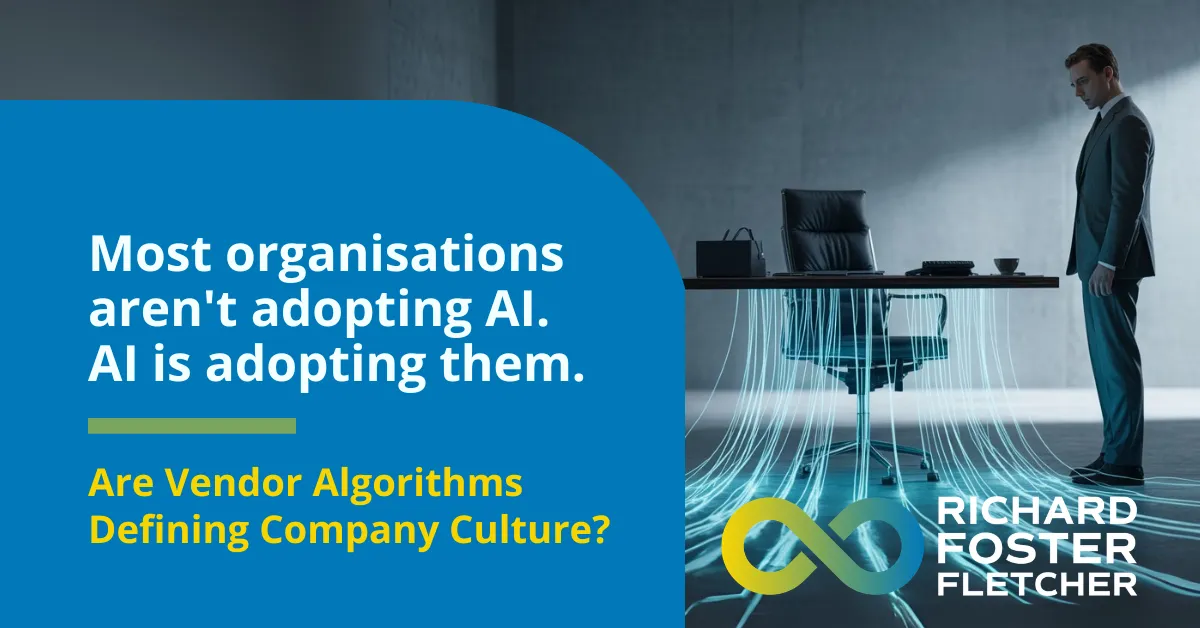
Most organisations aren't adopting AI. AI is adopting them.
8 September 2025
Are Vendor Algorithms Defining Company Culture?
AI-generated summary
Foster-Fletcher argues that adopting vendor AI platforms inverts control: organisations are not adopting AI so much as absorbing the encoded priorities of the companies that built it. Because these black-box systems update continuously for the vendor's own reasons, they steadily overwrite distinctive practices and reasoning, a cultural replacement he rates a deeper risk than technical dependency. He surveys responses, from self-hosting open models to diversifying providers to build judgement, and argues sustained discomfort may be the only real defence.
The efficiency gains from generative AI have been largely realised. Most organisations that wanted faster drafting, quicker analysis, and automated customer responses have them. The breathless headlines about productivity increases were accurate but incomplete. Now that the operational dust has settled, we can see what we've actually built: vast organisational dependencies on systems whose development we cannot influence and whose priorities we cannot control. Phase one asked "What can AI do?" Phase two asks "What is AI doing to us?" The answer is becoming clear, and it has little to do with efficiency.
When an organisation implements generative AI through vendor platforms, the technology doesn't just process tasks; it shapes how those tasks are conceived, structured, and evaluated.
What looks like AI adoption is, in practice, dependence on systems designed elsewhere. It is less a decision to adopt AI than a process of absorbing the strategic priorities of the companies that built the AI platforms.
This dependence works like having a consulting business you've never met, constantly influencing critical parts of your business. You cannot see their methodology. You don't know when they've replaced their consultants with someone different or even junior. You cannot brief them on your specific needs or challenge their assumptions. Yet this invisible consultancy shapes thousands of decisions across your organisation every day, from how customer issues are categorised to how strategic options are framed.
External AI systems like ChatGPT, Claude, Gemin and Copilot offer clear benefits. They work immediately, require minimal technical expertise, and avoid major capital investment. But organisations are discovering that the real cost isn't financial. It's losing the ability to shape how work gets done, what options are considered, and which trade-offs are acceptable.
Competitive advantage has often come from doing something differently from your competitors. When most organisations use the same AI services, processes are likely to converge. Customer interactions are at risk of becoming uniform, and strategic analyses could follow identical patterns.
The way external AI systems are built means that the unique approaches that once distinguished companies tend to get systematically erased. Many quirks, unconventional methods, and distinctive practices that made your organisation different get replaced by whatever patterns the AI vendor chose to reward during training. Their model doesn't know or care that your unusual customer service approach might be your competitive edge. It just knows that the approach doesn't match the patterns it learned from thousands of other companies' data, so it steadily guides you toward what it considers "correct.”
The technical architecture reinforces this convergence. These systems are black boxes by design. Their training data, reasoning processes, and targets for improvement remain hidden. When OpenAI or Google updates their models, they don't consult your strategic plan. When Anthropic or Microsoft adjusts their guardrails, they're solving for their liability, not your customer relationships. The accumulated effect of thousands of external decisions embeds itself in your operations.
Therefore, the deepest risk of AI adoption isn't technical dependency. It's cultural replacement: your organisation's distinctive judgment, accumulated wisdom, and ways of working get overwritten by whatever patterns the AI vendor has encoded as optimal.
How Your Organisation Gets Retrained Daily
Enterprise software traditionally offered predictable control. You decided when to upgrade and could assess what changed before implementation.
When AI adopts your organisation, this control inverts. The systems are updated continuously in response to regulatory pressure, competitive threats, and commercial priorities that have nothing to do with your business. The AI that shaped yesterday's decisions may reason differently today. Updates arrive without warning or explanation.
These changes don't just affect output quality. They are reshaping how your organisation thinks. Problems get reframed through the AI's new parameters. Solutions emerge from its adjusted priorities. Your teams adapt to each shift, usually without recognising they're being adapted. The AI isn't just processing your decisions anymore; it's training your organisation to think like it thinks.
When Vendor Updates Become Cultural Shifts
Organisational culture develops through repeated patterns of interaction. How questions are asked. How answers are evaluated. How decisions are justified.
This represents something I don’t think that boards have fully grasped: that by using these external platforms, they are effectively surrendering their organisational reasoning to external systems. The issue isn't whether any single modification improves or degrades performance; it’s that AI systems mediate thousands of these interactions daily, and these AI responses shape the cultural patterns that emerge. Teams adopt reasoning styles that reflect their tools. For example, your marketing team learns which prompts work, but "work" might just mean producing whatever patterns existed in the training data.
Each adjustment makes sense on its own.
The AI responds better to structured queries, so teams structure their queries. It handles certain complaint types well, so those get routed its way. It excels at specific document formats, so those become standard. Nobody decides to give up what makes them different. It happens one practical choice at a time.
Letting external AI systems shape your culture is tantamount to outsourcing your differentiation to companies that profit from standardisation.
Taking Control Back (If That's Still Possible)
So what exactly should an organisation do when it realises AI is doing the adopting? The conventional response would be to build control layers around AI infrastructure. Create your own frameworks, your own decision gates, your own spaces where AI doesn't reach.
These aren't bad ideas. But they assume you can identify what needs protection before it's too late. They assume you can see the influence while it's happening. They assume your organisation still remembers how to think without AI assistance. What if those assumptions are already wrong? What if the influence is already so embedded that even your AI-free zones are shaped by AI-influenced thinking?
Well-resourced organisations typically take several approaches to deploying AI. They might host open-source models like Llama or Mistral on their own infrastructure, giving them control over when and how updates happen. Some fine-tune these models on their proprietary data to better reflect their industry terminology, internal processes, and company-specific knowledge. Others negotiate enterprise agreements with vendors like OpenAI or Anthropic that include service-level agreements and sometimes the ability to opt out of certain updates.
These organisations usually build governance frameworks that specify which teams can use which models for which purposes. They create approval processes for new use cases and implement monitoring systems to track usage patterns. Many build custom interfaces that sit between users and the AI, adding their own prompting logic and output filtering to maintain consistency with company standards. They might run multiple models in parallel to compare outputs, using the differences to train their teams' judgment about AI responses.
For organisations without vast budgets, diversifying AI providers offers advantages. E.g. using Claude for complex reasoning, GPT for creative tasks, Gemini for data analysis isn't just about avoiding single-vendor capture. It's about developing organisational judgment. When you see how differently these systems approach the same problem, you start recognising their individual limitations. The variations between their outputs become teaching moments. Your teams learn that Claude might overthink where GPT oversimplifies, that Gemini's data analysis might miss nuances that Claude catches.
Using multiple AI systems builds judgment. When three LLMs give you three different answers, you stop treating AI output as truth and start recognising it as perspective.
This comparative exposure builds critical capability: the ability to spot when an AI is leading you astray. If three systems agree, that's worth noting. If they diverge, that's worth exploring. The differences between their responses reveal their respective blind spots, and more importantly, help you develop an instinct for when any AI response should be questioned. You're not just managing multiple dependencies; you're cultivating the organisational skill to recognise when external intelligence, regardless of its source, is pushing you toward conclusions that don't serve your interests.
The Black Box Running Your Business
In contrast to organisations actively managing their AI deployment, many others have rolled out internal LLMs without establishing basic visibility. The deployment might be technically successful (secure, compliant, running smoothly) but the organisation has no framework for understanding what they've actually deployed.
Your teams need to know exactly which model they're using, what version it is, and how it behaves. They should be able to sandbox new models before deployment, run comparative tests between different versions, and audit the outputs for consistency with organisational values. Without these capabilities, even an internal deployment becomes a black box.
If your IT department has deployed "something that works" but your teams can't tell you whether it's GPT-3.5 or GPT-4, Claude Sonnet or Claude Opus, Llama 3.1 or Mistral, then you're missing the critical middle layer between deployment and use. The difference between models isn't just performance; it's how they frame problems, what solutions they favour, and which patterns they reinforce in your teams' thinking. Technical deployment without organisational understanding means you're still letting external design choices shape your culture, just with better data protection.
Why Discomfort Might Be Your Only Defence
The organisations that thrive in phase two won't necessarily be those with the best AI strategies or the most sophisticated governance frameworks. They'll be those that maintain enough cognitive independence to recognise when they've lost it. But how do you measure something so intangible? How do you preserve capabilities you might not realise you're losing? How do you know if your strategic thinking is still yours?
Perhaps the answer isn't in the systems you choose or the processes you build. Perhaps it's in maintaining enough discomfort with the whole arrangement that you keep asking difficult questions. Not "How can we use AI better?" but "What is AI use doing to us?" Not "Which AI should we adopt?" but "What happens to organisations that forget how to think without assistance?" Not "How do we govern AI?" but "Who's really doing the governing?"
These questions don't have clean answers. That might be precisely why they're worth asking. The moment you think you've solved the AI adoption challenge is probably the moment you've been most thoroughly adopted. The organisations that stay uncomfortable, that keep questioning, that refuse to accept that this is just how things work now, they might be the ones that maintain enough independence to matter.